



CryoCore Down Sleeping Bag Design and Construction

Thermal performance, insulation distribution and weight reduction
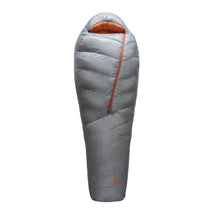
CryoCore is a down sleeping bag for lightweight backpacking, thru-hiking and multi-day travel. Its design objective is to meet the required level of warmth while reducing the weight and compressed volume carried on the trail. Thermal performance establishes the requirement; material selection and construction determine how efficiently that requirement can be met.
The range combines 850+ fill-power hydrophobic goose down, 10D downproof ripstop nylon and the GalbeLoft™ Baffle System. These components are developed as a coordinated insulation assembly: the down provides loft, the fabric contains it with minimal mass, and the internal construction controls its space and distribution. An angled zipper with two sliders provides access and ventilation without requiring the entire bag to be opened.
850+ fill power and the insulation weight
Down insulates by retaining air within its expanded structure. Fill power describes the volume occupied by a specified mass of filling under defined test conditions. Higher fill power provides more loft per unit mass, making it useful where insulation weight and compressibility are central design constraints.
CryoCore uses 850+ fill-power goose down with 95%+ down content. The purpose of this specification is to achieve the required insulation with less filling mass and a smaller compressed package. Fill power and fill quantity remain separate variables: a higher fill-power number does not remove the need for sufficient down, suitable chamber depth and consistent coverage.
The three temperature models therefore use different fill quantities. Regular versions contain 275 g / 9.7 oz in the 30°F model, 495 g / 17.5 oz in the 15°F model and 850 g / 30.0 oz in the 0°F model. Long versions receive additional filling to match their larger construction.
Independent testing of the down
The down used for CryoCore has been tested by IDFL. Under IDFB Part 10-B:2023 steam-conditioning procedures, the submitted sample measured 870 in³/30 g against an expected value of 850 in³/30 g. Composition analysis under IDFB Part 3:2020 measured 96.0% down clusters. These are sample-specific laboratory results; the product specification remains 850+ fill power and 95%+ down content.
The filling also receives a hydrophobic treatment intended to reduce wetting and help preserve loft in damp conditions. This material treatment complements the insulation design. The IDFL results cited here establish fill power and composition, rather than a quantified water-repellency performance.
GalbeLoft insulation distribution and chamber geometry
A sleeping bag’s total fill weight does not describe where its insulation is located. Thermal coverage also depends on chamber geometry, fill distribution and the way the assembled bag wraps around the sleeper. A locally underfilled or compressed area can interrupt otherwise adequate insulation.
The GalbeLoft™ Baffle System combines a contoured three-panel box-baffle construction with zoned filling and an adjusted upper-to-lower fill distribution. Internal baffle walls maintain separation between the shell and lining, providing space for down to expand while restricting its movement between chambers. The contoured main-body construction extends this controlled volume around the body and side areas.
Within that structure, filling is allocated according to the function of each region. The neck and chest collar zones, footbox and zipper draft tube receive dedicated filling configurations. The upper-to-lower distribution is also adjusted to account for the different conditions around and beneath the sleeper, including compression under body weight. The aim is to place the available down where it contributes effectively to the intended thermal coverage.
This approach addresses cold spots through both geometry and allocation. Chamber volume gives the filling room to loft; zoned filling matches the quantity to the region; and the contoured assembly connects these regions into a three-dimensional insulation system. The design objective is continuous coverage around the sleeper, including the transitions between the main body, collar, footbox and closure.

Hood and collar insulation
The head opening and upper-body closure require different treatment from the main body panels. CryoCore uses independently insulated chambers in the hood and collar assembly so these areas have their own controlled filling rather than depending on down in adjacent body chambers.
The hood provides coverage around the head and an adjustable opening. The neck and chest collar zones help restrict the exchange of warm air at the upper opening. Their role is to maintain insulation and control drafts where the main body’s enclosed volume meets an opening. Together with the main-body baffles, they form the upper portion of the thermal enclosure.

Footbox volume and local loft
The footbox must accommodate the natural position of the feet without forcing the toes against the shell. Local pressure can compress the filling and reduce the thickness of insulation around the toes, even when the overall bag length is sufficient.
CryoCore uses a three-dimensional footbox with a dedicated filling configuration. Its geometry provides space for the feet to rest naturally while helping preserve loft around them. Shape and filling are considered together: usable depth reduces contact pressure, while the allocated down provides insulation around that volume. This is a more useful design criterion than increasing bag length alone.

10D fabric and the non-fill weight
Once the insulation requirement is established, the shell, lining and components become important opportunities for weight reduction. Because fabric covers a large area, even a small change in fabric mass can affect the complete bag.
CryoCore uses 10D calendered downproof ripstop nylon for both shell and lining. The material is selected to reduce weight and compressed bulk while meeting the intended durability requirements of a backpacking sleeping bag. Calendering supports down containment, while the ripstop reinforcement helps limit tear propagation after local damage.
The fabric also needs to remain supple enough to accommodate the expansion of the filling. A lightweight shell and lining reduce the mass surrounding the down and allow the insulation assembly to compress efficiently for packing. The objective is to reduce fabric weight while retaining the containment, handling and durability needed for repeated use.
Angled zipper access and independent ventilation
CryoCore’s angled zipper is a principal ergonomic feature. Zipper placement affects how readily a sleeper can reach and move the slider from inside the bag. The angled path is designed to improve access and make opening and closing more natural, reducing the need to reach awkwardly along the side of the body.
The closure uses a YKK® No. 5 anti-snag zipper with two sliders, one at the upper end and one at the lower end. The layout supports convenient one-handed operation. The upper slider manages normal entry and exit. When less insulation is needed, the lower slider can be drawn upward to create a local ventilation opening while the rest of the bag remains closed.
Independent lower opening provides a practical means of releasing heat without removing coverage from the entire upper body. It also allows arm access where required. An insulated draft tube behind the zipper restores thermal coverage along the closure when it is shut. Access, ventilation and closed-state insulation are therefore addressed by the same assembly.

Fit and insulation volume
Regular is specified for users up to 183 cm / 6 ft tall; Long is specified for users up to 198 cm / approximately 6 ft 6 in. The listed internal dimensions are 191 × 77.5 cm / 75.2 × 30.5 in for Regular and 206 × 80.5 cm / 81.1 × 31.7 in for Long.
Fit influences both movement and insulation. The bag needs sufficient room for a natural sleeping position without persistent pressure at the shoulders or feet. At the same time, unnecessary volume adds fabric and filling. The additional down in Long models matches the larger construction so size and insulation are developed together.
Model specifications
|
Model |
Comfort |
Limit |
Down fill |
Weight |
Packed Weight |
Compressed Volume |
|
30°F Regular |
4°C / 39°F |
−1°C / 30°F |
275 g |
517 g |
565 g |
4.8 L |
|
30°F Long |
4°C / 39°F |
−1°C / 30°F |
315 g |
580 g |
628 g |
5.3 L |
|
15°F Regular |
−2°C / 28°F |
−9°C / 15°F |
495 g |
759 g |
816 g |
7.2 L |
|
15°F Long |
−2°C / 28°F |
−9°C / 15°F |
555 g |
842 g |
899 g |
8 L |
|
0°F Regular |
−10°C / 14°F |
−18°C / 0°F |
850 g |
1,134 g |
1,200 g |
10.3 L |
|
0°F Long |
−10°C / 14°F |
−18°C / 0°F |
950 g |
1,257 g |
1,323 g |
12 L |
Weight refers to the sleeping bag alone. Packed Weight includes the sleeping bag and compression sack, excluding the mesh storage sack. Compression sack weights are 48 g / 1.7 oz for both 30°F sizes, 57 g / 2.0 oz for both 15°F sizes and 66 g / 2.3 oz for both 0°F sizes. Compressed Volume is listed for each model and size.
Compression and carrying efficiency
High-loft down and low-mass fabric allow the insulation assembly to compress into a compact package. The 30°F Regular combines a bag weight of 517 g / 18.2 oz with a Packed Weight of 565 g / 19.9 oz and a Compressed Volume of 4.8 L. The colder models increase fill quantity and packed volume in line with their insulation requirements.
Each bag includes a compression sack for carrying and a mesh storage sack for loose storage between trips. Across the range, the engineering priority remains consistent: establish the required thermal coverage, distribute insulation effectively, and reduce the material and component weight needed to deliver it.
Down testing reference: IDFL report 26-1098163, issued 2 September 2026. Laboratory values cited above refer to the submitted down sample.

Leave a comment